Education · GLP-1 Basics

You’re in the middle of a work meeting. You just finished breakfast an hour ago. And yet — somewhere in the back of your mind — you’re already thinking about lunch.
Not because you’re hungry. Not because the food was bad. Just because your brain won’t stop.
What’s for dinner? Should I have had that second coffee? Did I eat too much yesterday? What if I just had a small snack now?
If this sounds familiar, there’s a name for it: food noise.
And if you’ve spent years assuming it meant something was wrong with you — that you lacked discipline, focus, or willpower — this article is going to offer a very different explanation.
What Is Food Noise?
Food noise is the term used to describe the constant, intrusive mental chatter about food that many people experience throughout the day. It’s not hunger in the traditional sense. It’s more like a background hum that never fully turns off — a persistent preoccupation with what you’ve eaten, what you’re about to eat, and whether any of it was the “right” choice.
For some people, food noise is mild. For others, it’s consuming — an exhausting mental loop that makes it genuinely difficult to focus on work, relationships, or anything else.
Common Experiences
- Thinking about your next meal before you’ve finished the current one
- Replaying food decisions and second-guessing them hours later
- Feeling like food occupies mental space even when you’re not physically hungry
- Struggling to eat “just a little” of something without it triggering a spiral of thoughts
- Feeling controlled by cravings rather than in control of them
It’s worth saying clearly: food noise is not a character flaw. It is not evidence of weakness, poor discipline, or a lack of effort. For millions of people, it is a biological reality — and understanding why it happens changes everything.
Why Does Food Noise Happen?
To understand food noise, you need to understand a small but powerful hormone called GLP-1, or glucagon-like peptide-1.
GLP-1 is produced naturally in your gut after you eat. Its job is to signal to your brain that you’ve had enough — to create that feeling of satisfaction that tells you you can stop now. It also slows digestion, regulates blood sugar, and influences the reward circuits in your brain that make food feel compelling.
In people who experience significant food noise, those GLP-1 signals are often weaker or shorter-lived than they should be. The “satisfied” message doesn’t arrive clearly — or doesn’t last long enough. So the brain keeps searching. Keeps asking. Keeps thinking about food, because on some level it hasn’t received a reliable signal that it’s okay to stop.
This is also why dieting alone is so frustrating for so many people. Eating less doesn’t fix the underlying signaling problem. If anything, caloric restriction can amplify food preoccupation — your brain, sensing scarcity, gets louder, not quieter.
It’s biology.
Not willpower.
Curious whether a GLP-1 program might be appropriate for you?
Takes a few minutes · No commitment required
The GLP-1 Connection — And Why It Matters
This is where GLP-1 medications enter the picture.
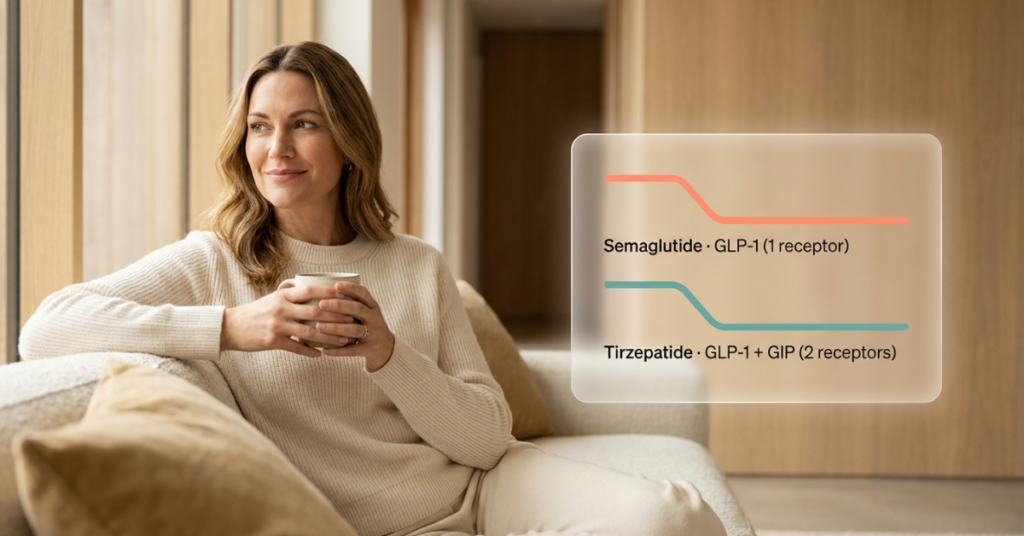
Medications like semaglutide and tirzepatide are part of a class called GLP-1 receptor agonists — they work by mimicking and amplifying the effects of your body’s natural GLP-1. When used under medical supervision as part of a structured program, they help restore the signaling that regulates appetite, satiety, and the brain’s relationship with food.
What many patients describe — sometimes within the first few weeks of treatment — is not just eating less. It’s something more fundamental:
The mental chatter quiets down.
The constant negotiation with food softens. The intrusive thoughts about what to eat, when to eat, and whether you “should” eat become less frequent and less intense. For people who have lived with food noise for years or decades, this shift can feel remarkable — not because they’re suppressing hunger by force, but because the biological signal that was always supposed to be there starts working properly.
It’s the difference between white-knuckling through a diet and simply not feeling pulled toward food in the same way.
This Isn’t About Eating Less — It’s About Thinking Differently
One of the most important things to understand about GLP-1 treatment is what it doesn’t do.
It doesn’t eliminate hunger entirely. It doesn’t remove your enjoyment of food. It doesn’t change who you are or how you relate to meals, social eating, or the pleasure of a good dinner with people you love.
What it can do — for the right candidate, in a medically supervised program — is reduce the noise. The background anxiety. The mental exhaustion of a brain that was working overtime on a problem it couldn’t solve alone.
“Many women describe it as finally being able to think about something else.”
Is Food Noise Something Your Doctor Can Address?
If food noise has been part of your life for a long time, it may feel so normal that you’ve never thought to mention it in a medical setting. Or you may have brought it up and felt dismissed — told to try harder, eat slower, or practice mindfulness.
GLP-1 medications are not right for everyone, and eligibility depends on a full medical evaluation — including your health history, current medications, and clinical factors like BMI. But for many adults who have struggled with persistent food preoccupation alongside weight management challenges, these medications represent a genuinely different kind of intervention.
Not another diet. Not another rule to follow. A tool that works with your biology instead of against it.
What a Medically Supervised GLP-1 Program Looks Like
At Your Infinity Health, the process starts with a straightforward eligibility form — no commitment required until you see your options. A licensed provider reviews your case individually, evaluates whether a GLP-1 program is appropriate for you, and walks you through your choices.
What’s Included
If you’re a candidate, your program includes:
- Personalized treatment — semaglutide or tirzepatide, selected based on your clinical profile
- Monthly provider check-ins — not just a prescription and a goodbye
- Ongoing support — meal guidance, wellness coaching, and someone to contact if you have questions
- Medication delivered to your door — from a licensed, LegitScript-certified pharmacy in the U.S.
|
Semaglutide $199/month |
Tirzepatide $299/month |
No price increases as your dose adjusts
Compounded medications used in this program are not FDA-approved finished products. Individual results vary. Eligibility is determined by a licensed medical provider.
Ready to See If This Is Right for You?
If you’ve spent years managing food noise on your own — trying diets, tracking calories, negotiating with yourself about every meal — you know how exhausting it is.
You also know that effort alone hasn’t been the missing ingredient.
If you’re curious about whether a physician-supervised GLP-1 program might be appropriate for your situation, the first step is simply filling out the eligibility form. No obligation, no pressure — just a straightforward conversation with a licensed provider who will review your case and give you honest information.
Your Next Step
Start your eligibility form
A licensed provider will review your case and give you honest information — no pressure, no obligation.
The information in this article is intended for educational purposes only and does not constitute medical advice. GLP-1 medications require a prescription and should only be used under the supervision of a licensed healthcare provider. Compounded medications are not FDA-approved finished products. Eligibility is determined on an individual basis by a medical professional.